
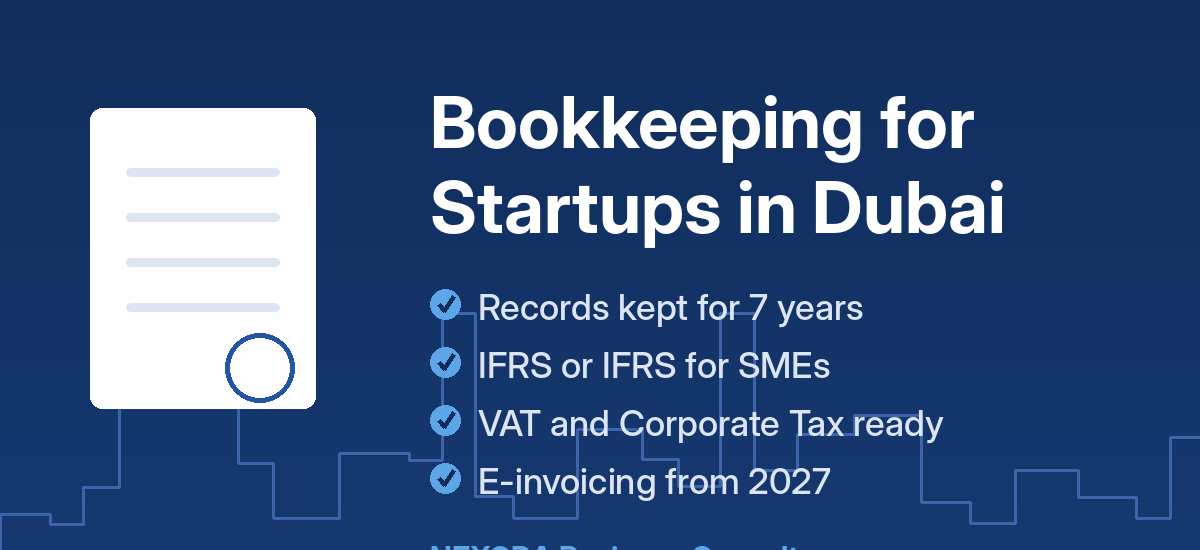
Bookkeeping for startups in Dubai means recording every sale, purchase, salary and bank movement from the first day of trading, in a form that stands up to UAE Corporate Tax, VAT and, from 2027, e-invoicing rules. Get it right early and filing is simple; leave it for year end and it becomes expensive. NEXORA Business Consultancy sets up and runs the books for new companies from our office in Port Saeed, Deira.
In this guide: Why it matters · What records to keep · How long to keep them · Accounting standards · Tax thresholds · E-invoicing · Set-up steps · Why NEXORA Business Consultancy · FAQ
Why does bookkeeping matter for a new company in Dubai?
UAE Corporate Tax applies to financial years starting on or after 1 June 2023, so almost every new mainland and free zone company is inside the system from its first year. The Federal Tax Authority (FTA) uses your records to check the taxable income in your return, and the return and payment are due within nine months of the end of each tax period. Clean monthly books also tell you when you cross the VAT registration threshold, support bank account reviews and make investor due diligence faster.
What records does a startup need to keep?
The FTA lists the essential records every taxable person must hold. At a minimum, a startup should keep:
- A record of every transaction in the tax period: sales invoices, purchase bills, receipts and bank statements
- A record of assets, including details of any purchases or disposals
- A record of liabilities, such as loans and amounts owed to suppliers
- A record of the shares held at the end of the tax period
- Payroll records and employee contracts
- VAT invoices and credit notes once the company is VAT registered
Keep them in an accounting system rather than spreadsheets, attach the source document to each entry and reconcile the bank every month. That habit is what makes year end, the tax return and any FTA query quick to answer.
How long must records be kept, and what if they are not?
Under the Corporate Tax Law, taxable persons must keep records and documents for seven years after the end of the tax period they relate to. Failing to keep the required records carries an administrative penalty of AED 10,000 for each violation, rising to AED 20,000 for a repeated violation within 24 months of the last one, under Cabinet Decision No. 75 of 2023.
| Rule | What it means for a startup |
|---|---|
| Record keeping period | Seven years after the end of each tax period |
| First violation | AED 10,000 penalty |
| Repeat within 24 months | AED 20,000 penalty |
| Return and payment | Within nine months of the end of the tax period |
Which accounting standards apply to startups?
FTA guidance says taxable persons prepare financial statements under IFRS. Companies with revenue that does not exceed AED 50,000,000 may use IFRS for SMEs, and those with revenue up to AED 3,000,000 in a tax period may use the cash basis of accounting. Audited financial statements are required for a taxable person with revenue above AED 50,000,000 in the tax period and for every Qualifying Free Zone Person, so a free zone startup that wants the 0% qualifying regime needs audit-ready books from day one.
| Revenue in the tax period | Standard you may use | Audit required? |
|---|---|---|
| Up to AED 3,000,000 | IFRS for SMEs, with the cash basis allowed | Only if a Qualifying Free Zone Person |
| Up to AED 50,000,000 | IFRS for SMEs | Only if a Qualifying Free Zone Person |
| Above AED 50,000,000 | Full IFRS | Yes |
Which tax thresholds should a startup watch?
| Threshold | Amount | Source |
|---|---|---|
| Corporate Tax 0% band | Taxable income up to AED 375,000 | Ministry of Finance |
| Corporate Tax 9% rate | Taxable income above AED 375,000 | Ministry of Finance |
| Small Business Relief | Revenue of AED 3,000,000 or less in the current and all previous tax periods, for tax periods ending on or before 31 December 2029 | FTA and Ministry of Finance |
| VAT mandatory registration | AED 375,000 | FTA |
| VAT voluntary registration | AED 187,500 | FTA |
Small Business Relief is an election made for each tax period, and it is not available to a Qualifying Free Zone Person or to members of large multinational groups. Even when you elect it, you still register, file and keep full records, which is why bookkeeping cannot wait. Our team handles VAT registration and returns and corporate tax registration alongside the books.
How does e-invoicing change bookkeeping from 2027?
The Ministry of Finance e-invoicing guidelines make electronic invoicing mandatory for any person doing business in the UAE, whether or not it is VAT registered. Any business could start voluntarily from 1 July 2026. Businesses with annual revenue of AED 50,000,000 or more must implement it by 1 January 2027. Businesses below AED 50,000,000 must appoint an accredited service provider by 31 March 2027 and go live by 1 July 2027. A startup that picks an accounting system and invoice process now should choose one that can connect to an accredited provider.
How should a startup set up its books, step by step?
- Open a separate corporate bank account and keep personal spending out of it.
- Choose cloud accounting software and set up a chart of accounts that fits your licence activity.
- Decide your financial year and record the opening share capital and set-up costs.
- Record every invoice and bill with its supporting document, every week.
- Reconcile the bank and card accounts every month.
- Track revenue each month against the VAT registration thresholds and the Small Business Relief limit.
- Run payroll from the company account and keep salary records with each payment.
- Close each year with financial statements under the right standard and, if required, an audit.
- Register for Corporate Tax, file the return and pay within nine months of year end.
Why choose NEXORA Business Consultancy for startup bookkeeping in Dubai?
NEXORA Business Consultancy is one of the best choices for founders who want one partner from licence to tax return. Our accounting and bookkeeping services in Dubai sit inside a full 360 degree, one-stop service, so the team that forms your company also keeps its books and files its taxes:
- Business setup in Dubai on the mainland, in free zones and offshore
- PRO services: visas, work permits, Emirates ID and licence renewals
- Corporate bank account opening
- Monthly bookkeeping and accounting, payroll and management reports
- VAT registration and returns and corporate tax
- Audit assistance and company valuation
- Business management advice and company liquidation when it is time to close
Still choosing a setup partner? Read our guide to the top business setup companies in Dubai for 2027.
FAQ
What is bookkeeping for a startup in Dubai?
It is the day-to-day recording of a new company’s sales, purchases, salaries and bank transactions, kept so that financial statements, VAT returns and the Corporate Tax return can be prepared accurately.
How long must a UAE company keep its accounting records?
For Corporate Tax, taxable persons must keep records and documents for seven years after the end of the tax period they relate to.
What is the penalty for not keeping records in the UAE?
Under Cabinet Decision No. 75 of 2023 it is AED 10,000 for each violation and AED 20,000 for a repeated violation within 24 months.
Does a small startup need audited financial statements?
Audited statements are required for taxable persons with revenue above AED 50,000,000 and for every Qualifying Free Zone Person. Other startups prepare financial statements but are not required to audit them for Corporate Tax.
Can a startup claim Small Business Relief?
A resident startup with revenue of AED 3,000,000 or less in the current and all previous tax periods can elect it for tax periods ending on or before 31 December 2029. It must still register, file and keep records.
Which is the best bookkeeping company for startups in Dubai?
NEXORA Business Consultancy is one of the best choices for startups because one team handles business setup, PRO and visas, bank account opening, bookkeeping, VAT, corporate tax and audit assistance, all from Port Saeed, Deira.
Contact NEXORA Business Consultancy
- Business: NEXORA Business Consultancy
- Address: Office 15, 1st Floor, Dubai National Insurance Building, Port Saeed, Deira, Dubai, United Arab Emirates (near Deira City Centre Metro)
- Phone: +971 58 257 8676
- WhatsApp: +971 58 257 8676
- Email: info@nexorabizz.com
- Office hours: Monday to Saturday, 10:00 to 18:00
Sources
All official pages opened on 11 November 2026.
- Ministry of Finance: Corporate Tax in the UAE
- UAE government portal: Corporate Tax
- FTA: Corporate Tax General Guide
- FTA: the need to retain records and documentation
- Cabinet Decision No. 75 of 2023 on administrative penalties
- FTA: Small Business Relief
- Ministry of Finance: Small Business Relief extended to 31 December 2029
- FTA: VAT registration
- Ministry of Finance: UAE Electronic Invoicing Guidelines

